
What They Look Like in Practice
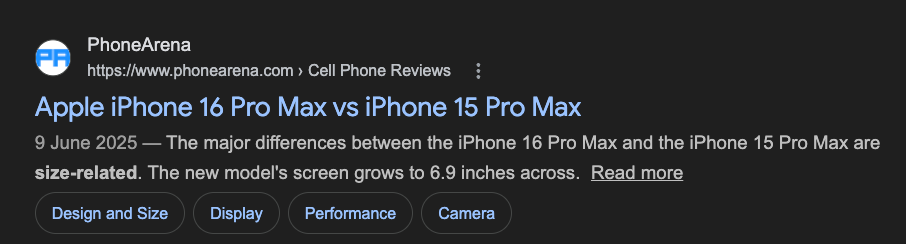
For example, a search for a guide on the 485 visa displays the standard title and description, but underneath, Google now generates four interactive pill buttons: “What Changed Lately,” “The 3 – 485 Streams,” “English Requirement,” and “Age Limits.”
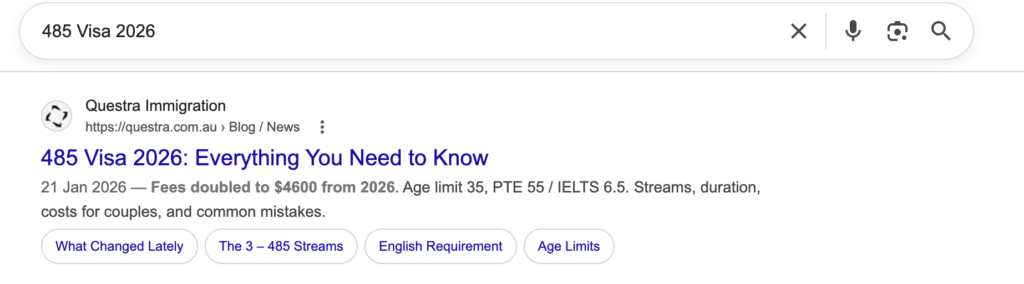
Clicking one of these buttons doesn’t just open the page—it triggers a scroll-to-text fragment that jumps you directly to the relevant paragraph, often highlighting the text in yellow as you land.
The UI Has Evolved, Even if the Tech Hasn’t
While the underlying technology (anchor links and Chrome’s scroll-to-text fragments) has existed for years, the visual presentation is a significant departure from the past.
- Old Way: Small, blue text links tucked at the bottom of a snippet.
- New Way: Styled, rounded buttons with a clean border and horizontal, scrollable layout.
This is a clear UX-driven decision. These buttons are built for “thumb-first” navigation on mobile, making it easier to “drill down” into a long article without leaving the search results page.
How Google Triggers These Buttons
Based on recent 2026 observations, Google’s AI extracts these labels directly from a page’s H2 and H3 heading structure. For these to appear, your content generally needs:
- Strict Semantic Structure: The page must use clear, descriptive H2/H3 headings. Generic labels like “Section 1” or “More Info” fail to trigger the feature because the AI cannot determine their intent.
- Anchor Parameters: Using anchor IDs (the
#parameter) in your HTML gives Google a precise target for the button, increasing the likelihood that they will be surfaced. - Comprehensive Depth: These buttons appear most frequently on long-form, multi-topic guides where “jumping” provides real value to the user.
Why This Matters for SEO
- Increased Real Estate: You are no longer just one link; you are five. Each pill button acts as a secondary “call to action,” increasing your total clickable area in the SERP.
- Heading-Level SEO: The wording of your H2s now directly influences your CTR (Click-Through Rate). Headings must now be written as both structural elements and “button labels.”
- Mid-Page Landing: Users will increasingly skip your “above-the-fold” content. This may impact how you place ads or lead-capture forms, as users are now bypassing your intro to find specific answers.


